© 2009 DAVID KAETZ
The world into which Moshe Feldenkrais was born is quickly passing from living memory, though it has left an indelible imprint on the modern world. I speak here of the lost world of Eastern European Jewry. When Moshe was teaching in Tel Aviv, there were many people around who remembered it, and much of what is written in Making Connections would have been taken for granted. Now, however, when Moshe’s teachings have gone out all around the world, there are fewer and fewer around who remember where Moshe came from, and what that might tell us about the man and his teachings.
Moshe was born in the so-called Pale of Settlement, the western border regions of the old Russian Empire, which is today made up of the countries of Lithuania, Belarus, Poland, Ukraine, Moldova and some parts of Russia itself. In this region, stretching from the Baltic Sea in the north-west to the Crimean peninsula on the Black Sea in the south-east, there developed, over the course of nine centuries, the most thoroughly idiosyncratic Jewish culture that the Diaspora has produced.In the words of the late Hasidic scholar, poet, and civil rights activist Rabbi Abraham Joshua Heschel, it was in that place and time that the Jewish people attained its “highest degree of inwardness.” Not unrelatedly, in that same place and time, it experienced its lowest degree of integration with the surrounding cultures.1
This was a culture with not one but three of its own languages—two sacred and one secular—a culture that placed the highest value on scholarship and intellectual ingenuity. Though most of its people were very poor, literacy, if not in Hebrew and Aramaic, then in Yiddish, was close to universal. It was a world, writes Heschel, where “the sense of a man’s life lies in his perfecting the world.”2These were Moshe’s people, and this—despite all the transformations he experienced—was the sense of Moshe’s life.
The Hasidic movement, a spiritual and social impulse that emerged in what is now Ukraine and went on to change the face of Jewish civilization, is one of the most remarkable creations of that culture. Judaism had always had a mystical side to it, sometimes embraced, sometimes held at a distance. Hasidism took the core of Jewish mysticism, the unity and inseparability of creator and creation, and placed it squarely in the centre of society. Charismatic and warm-hearted, Hasidism brought back to European Judaism an appreciation of the sensual universe, of music and dance, of joyous camaraderie, and of one’s personal responsibility for one’s own improvement.
On his mother’s side, Moshe’s lineage is said to go back to one of the major figures of the movement, the legendary and beloved rabbi-teacher-leader-healer-counsellor—(it’s a lot easier to use the Hebrew word, Tzaddik)—Rabbi Pinchas Shapiro of Koretz. Moshe spoke often, and with pride, of this connection. On his father’s side, there was another luminary who also figured prominently in Moshe’s sense of himself. In his autobiographical video (1983),3 he goes on at length about Rabbi Yonah, “the good and the beneficent.”
In the civilization from which Moshe emerged there has always been a diversity of voices. Some have been more conservative, and some, like the prophets of the Hebrew Bible, have raged at the established order, or simply set about to change it. The fact that Moshe ate bacon on his way to the founding of the State of Israel does not shut him out of the conversation with his ancestors. If Abraham was the first Jew, he was also the first Jew to smash idols; and then there were the prophets, and Jesus, and Spinoza, and Marx, and Einstein, and Freud, et al. You get the picture.
Moshe’s own life was devoted, not to repeating the same answers as his forefathers, but to answering as freshly and concretely as possible the same questions as his forefathers. And, in this— using some of the old tools and many new ones— he was more successful than many.
When Rabbi Noah, Rabbi Mordechai’s son, assumed the succession after his father’s death, his disciples noticed that there were a number of ways in which he conducted himself differently from his father, and asked him about this.“I do just as my father did,“ he replied. “He did not imitate, and I do not imitate.”4
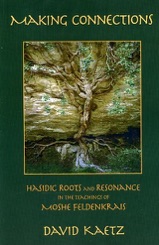
Who were Moshe’s Hasidic forebears, and why were they so revered? And what about their teachings, according to which all aspects of the universe are seamlessly interconnected, and the slightest movement in any realm is felt throughout? And what, you may ask, do this lineage and these teachings have to do with what Moshe taught? These were among the many questions I asked myself as I set out on an adventure—an adventure of which the book Making Connections, and a multi-media presentation of the same name, constitute the reportage. It is my hope that they will provide an environment in which connections will make themselves.
___________
1 Abraham Joshua Heschel, “The Eastern European Era in Jewish History,” in Deborah Dash Moore, ed., East European Jews in Two Worlds: Studies from the YIVO Annual (Evanston: Northwestern University Press, 1990) 2. 2 Heschel, 13. 3 Moshe Feldenkrais, autobiographical interview, unpublished video recording (Paris: International Feldenkrais Federation, 1981). The IFF Archive of the Feldenkrais Method was established in 2002 with the generous support of the Feldenkrais family, represented by Michel Silice Feldenkrais. 4 Martin Buber, ed., (O. Marx, trans.) Tales of the Hasidim: The Later Masters (New York: Schocken Books, 1948) 157.
All content copyright © 2009 D. Kaetz. Web design copyright © 2009 www.fidlweb.com